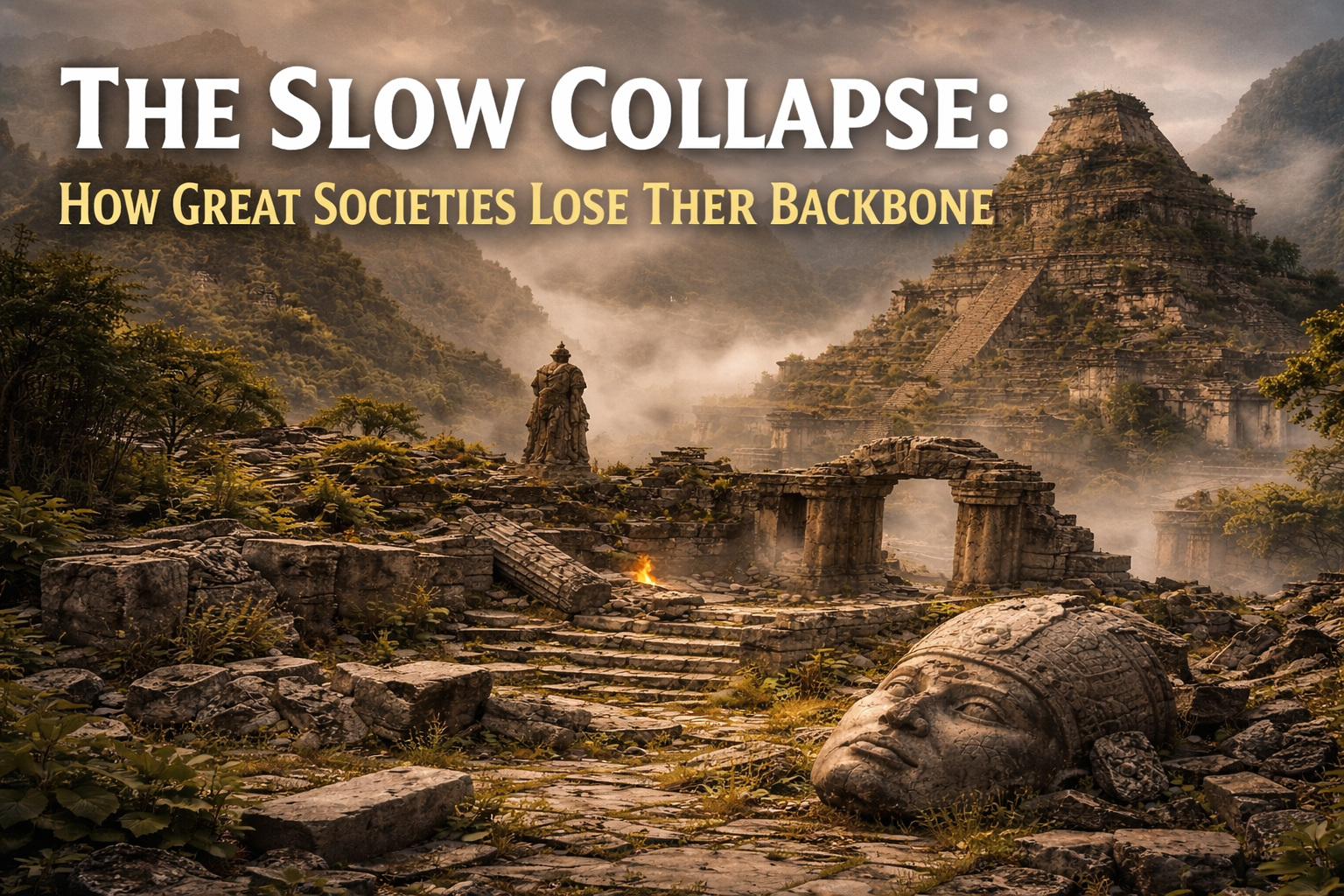
Imagine sitting by a quiet fire late at night. The flames are steady, and the room feels calm. Someone begins telling a story about a powerful civilization that once seemed unstoppable. Its cities were strong, its people confident, and its future seemed guaranteed.
But today, that civilization is only remembered in books and ruins.
What happened?
Companion song: Signal Before the Break
Most people assume great societies collapse suddenly — through war, invasion, or financial disaster. History does show moments like that. But those dramatic events are often just the final scene. The real collapse usually begins long before anyone notices.
It begins slowly.
At the beginning of most great societies, people understand hardship. The early generations struggle to build farms, roads, homes, and systems of law. They cooperate because survival requires it. Personal responsibility is strong because there is no other option.
People know that if they do not work together, the whole structure falls apart.
Over time, success changes things.
As the civilization grows wealthy and comfortable, later generations inherit systems they did not have to build. The roads are already paved. The markets already function. Food appears easily, and stability feels permanent.
Because of this, the memory of struggle slowly fades.
When that memory fades, something deeper begins to weaken: the backbone of the society.
A civilization’s backbone is not its buildings or its armies. It is the character of its people — their willingness to sacrifice, work, and protect the institutions that hold everything together.
When that backbone weakens, the signs appear quietly.
Responsibility is slowly replaced with convenience.
Discipline is replaced with comfort.
Long-term thinking gives way to short-term pleasure.
People begin assuming the system will always work, no matter how little effort they put into maintaining it.
During this period, the society may still appear strong from the outside. The cities remain large. The economy may still function. Technology may even advance rapidly.
But underneath the surface, something essential has changed.
Fewer people feel responsible for protecting the system.
More people feel entitled to simply benefit from it.
History shows this pattern again and again. The later Roman Empire experienced it. So did many once-powerful empires across Asia, Europe, and the Americas.
The collapse rarely begins with the loss of wealth or power.
It begins with the loss of shared purpose.
When enough people stop believing they are responsible for the future, the foundations quietly erode. Institutions weaken. Trust declines. Cooperation becomes harder.
Eventually a shock arrives — a war, economic crisis, or political conflict.
Observers often point to that moment as the cause of collapse.
But in reality, the civilization had already been weakening for many years. The crisis simply revealed the damage that had been building all along.
The slow collapse is rarely obvious while it is happening.
From inside the society, everyday life continues. People go to work, raise families, and enjoy entertainment. The warning signs feel abstract or exaggerated.
Only later, when historians look back, does the pattern become clear.
The quiet fading of a civilization’s backbone.
Yet this story is not only about decline.
It is also a reminder.
Civilizations are not destroyed only by enemies from the outside. They are preserved or weakened by the habits, discipline, and responsibility of the people within them.
The strength of a society is not measured by its monuments.
It is measured by the character of the people who maintain them.
And like the fire in front of us tonight, that strength must always be tended.
If people stop feeding the fire, even the brightest flame will slowly fade. 🔥